Cynthia Ursino · Behavioral Ecology

Welcome!

I study the ecology and evolution of bird behavior, with a particular focus on mating systems, brood parasitism, ecto-parasitism, cooperative behavior, and parental care.
The aim is to understand how these systems evolve in response to ecological and evolutionary pressures. I combine behavioral observations, genetic analysis, and field experiments, with fieldwork conducted in Argentina and lab work in the US. Currently, I investigate the dynamics of species with and without parental care, exploring how reproductive strategies such as cooperative breeding and brood parasitism influence social and genetic mating behaviors

Publications

Google Scholar | * denotes corresponding author | Equal contribution

If you do not have access to any of these articles and would like a copy, please feel free to email me at cursino@princeton.edu
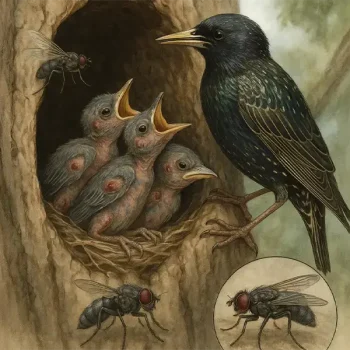
Illustration of an adult Starling feeding his three chicks on the nest (hole in a tree)
19. Ursino, C.A.*; Palacios, M.G.; Ibañez, L.M. & Fiorini, V.D. (2024)

Enemy of the invader: impact of the native ectoparasite Philornis spp. on an invasive bird species, the European starling (Sturnus vulgaris)
Biological Invasions, 26(5): 1413–1424
DOI: 10.1007/s10530-024-03256-y
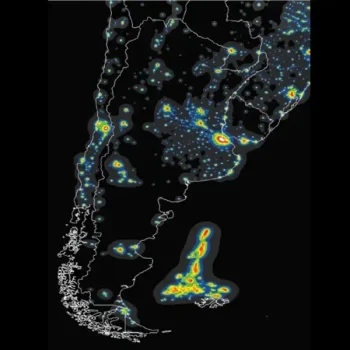
Argentina in a dark map. There are some colour spots marking the light pollution
18. Ursino, C.A.*; Rebolo-Ifrán, N. & Gorleri, F. (2022)

Impacts of light pollution on birds with a special focus on Argentina
El Hornero, 37(2): 33–37
DOI: 10.56178/eh.v37i2.393
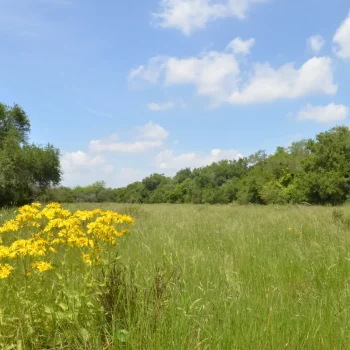
Grassland surrounded by a forest, with yellow flowers
17. Yang, C.; Peer, B.; Ursino, C.A.; Yu, J. & Rivers, J.W. (2022)

Evolution and Function of Acoustic and Visual Signals in Avian Brood Parasitism

Frontiers in Ecology and Evolution
DOI: 10.3389/fevo.2022.892373
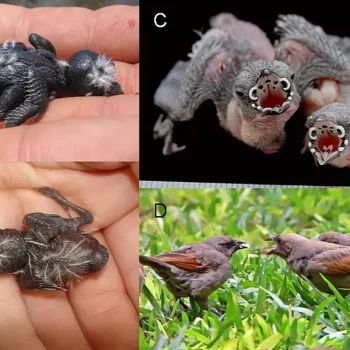
16. Ursino, C.A.*; Lama, F.; Reboreda, J.C. & De Mársico, M.C. (2022)

Vocal trickery allows the specialist brood-parasitic Screaming Cowbird juveniles to escape host discrimination after leaving the nest
Behavioral Ecology and Sociobiology
DOI: 10.1007/s00265-022-03175-9
Four different young Screaming Cowbirds
15. Rojas Ripari, J.M.; Ursino, C.A.; Reboreda, J.C. & De Mársico, M.C. (2021)

Tricking Parents: A Review of Mechanisms and Signals of Host Manipulation by Brood-Parasitic Young
Frontiers in Ecology and Evolution
DOI: 10.1007/s00265-022-03175-9
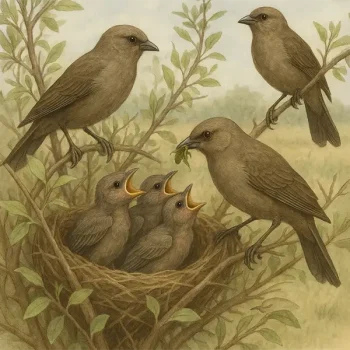
Illustration of a family of Baywings feeding chicks on the nest
Ursino, C.A. (2008)

Composición del grupo social y contribución de sus miembros al cuidado de los juveniles en una especie con cría cooperativa, el Tordo Músico Agelaioides badius (Aves, Icteridae)
Facultad de Ciencias Exactas y Naturales, Universidad de Buenos Aires
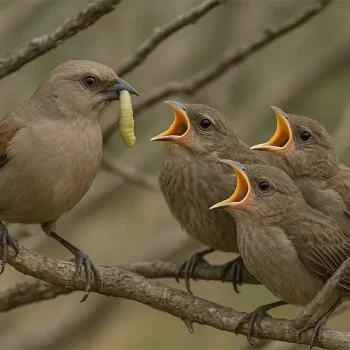
An Adult Baywing bird feeding insects to three chicks
Ursino, C.A. (2016)

Efecto de dos parásitos de cría sobre el cuidado parental de una especie con cría cooperativa, el Músico (Agelaioides badius)
Facultad de Ciencias Exactas y Naturales, Universidad de Buenos Aires
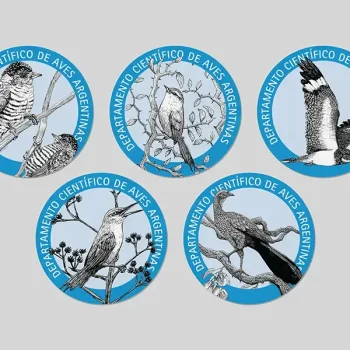
Decorative for the article "Nueva etapa del Departamento Científico de Aves Argentinas"
Ursino, C.A. & Roesler, I. (2020)

Nueva etapa del Departamento Científico de Aves Argentinas
Revista Aves Argentinas, 59: 38
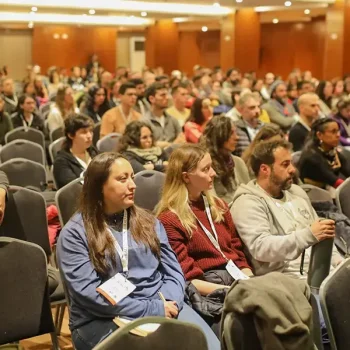
Decorative for the article "Libro de resúmenes XIX RAO"
Ursino, C.A. & Roesler, I. (2022)

Ciencia en Aves Argentinas

Libro de resúmenes XIX RAO
Decorative for the article "Biblioteca digital de Aves Argentinas"
Ursino, C.A.; Roesler, I.; Jefferies, M. & del Castillo, M. (2024)

Biblioteca digital de Aves Argentinas
Revista Aves Argentinas, 70: 38
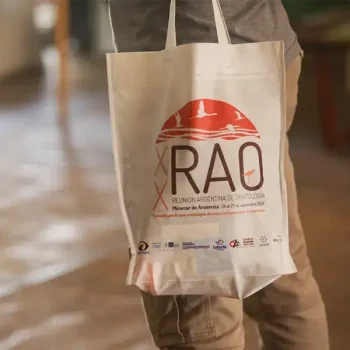
Decorative feature for the article "Libro de resúmenes XX RAO"
Ursino, C.A. & Roesler, I. (2024)

Ciencia en Aves Argentinas

Libro de resúmenes XX RAO
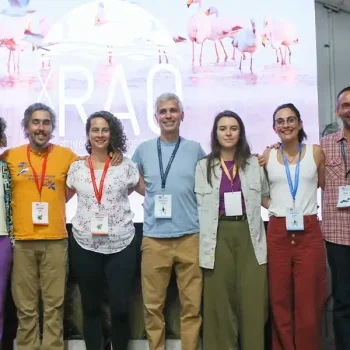
Group photo of the members of the Aves Argentinas Scientific Department
Jefferies, M.; Ursino, C.A. & Roesler, I. (2024)

XX Reunión Argentina de Ornitología en Miramar de Ansenuza

Revista Aves Argentinas, 71: 38

CV

Education

2016

PhD in Biological Sciences. University of Buenos Aires.

2016
2008

Licenciatura in Biological Sciences (equivalent to Master’s). University of Buenos Aires.

2008

Research Appointments

2022–present

Postdoctoral Research Fellow at Princeton University.

2022–present
2020–present

Director of the Scientific Department at Aves Argentinas.

2020–present
2019–2022

Presidential Postdoctoral Research Fellow at Princeton University.

2019–2022
2017

Fulbright Fellow - Visiting Post-Doctoral Scholar at Princeton University.

2017
2016–2019

Postdoctoral Argentinean National Science Council (CONICET) Fellow at University of Buenos Aires.

2016–2019
2014–2015

Visiting Graduate Student Fellow at Harvard University.

2014–2015
2011–2016

Graduate Student CONICET Fellow at University of Buenos Aires.

2011–2016

Service

2025–Present

Associate Editor Ornithology.

2025–Present
2025–2027

Member, AOS Committee.

2025–2027
2024–Present

Associate Editor Frontiers in Bird Science.

2024–Present
2023–Present

Associate Editor El Hornero.

2023–Present
2021

Guest Editor Frontiers in Ecology and Evolution.

2021
Illustration of a Baywing bird sitting on a branch. The bird seems to be singing

Collaborators

I am fortunate to collaborate with outstanding researchers and research teams. Below are some of the key collaborators whose contributions have significantly shaped my work:

Community Roles

Thanks

I am grateful to the following institutions for their support and funding, and for being part of my professional, academic, and research journey.

Research

Mating System

My research on mating systems focuses on understanding the diverse reproductive strategies across species. I investigate how parental care shapes mating behaviors and how these behaviors influence genetic diversity within populations, particularly in species with and without parental care. By studying the mating systems of birds, I aim to uncover patterns of monogamy, promiscuity, and other complex social structures.
Mating systems of brood parasites are of particular interest in my research because these systems have evolved in the absence of parental care. Brood parasites, such as the Shiny Cowbird (Molothrus bonariensis) and Screaming Cowbird (Molothrus rufoaxillaris), are expected to be more promiscuous, given their reliance on other species to raise their offspring. However, behavioral observations reveal that while Shiny Cowbirds exhibit promiscuous mating behaviors, the Screaming Cowbirds may actually follow a more monogamous system, challenging the conventional understanding of parasitic mating systems.
Additionally, I study species with cooperative breeding systems, such as the Baywing (Agelaioides badius) and the Brown and Yellow Marshbird (Pseudoleistes visceralis), which offer a contrasting social structure. In these species, multiple individuals help raise the young of a single breeding pair, which provides insights into the evolution of social behaviors. This cooperative behavior may also shape the social and genetic mating systems, influencing both individual and group-level fitness. Understanding how social dynamics drive cooperative breeding offers a unique lens to examine the evolution of mating systems in birds.
My research combines behavioral observations and genetic analysis to explore how these mating systems evolve and how social structures influence mating strategies. Using advanced techniques such as double-digest restriction-site associated DNA sequencing (ddRad-seq) and mitochondrial DNA analysis, I aim to reconstruct family trees and uncover the genetic underpinnings of these mating systems.

Research

Brood Parasitism

Brood parasitism is a reproductive strategy in which one species relies on another to raise its offspring, avoiding the costs of parental care such as feeding and protecting the young. In birds, brood parasites lay their eggs in the nests of other species, leaving the host to care for the parasite’s young. My work focuses on understanding the eco-evolutionary consequences of the coevolutionary “arms races” that emerge between avian brood parasites, such as cowbirds, and their hosts. These arms races involve a continuous cycle of adaptation and counter-adaptation, where both parasites and hosts evolve new strategies to outcompete each other.
Through this research, I aim to answer several important questions: How do host species evolve mechanisms to detect and reject parasitic nestlings and fledglings? How do brood parasites exploit the host species, and how do they adapt to avoid host defenses? How do these parasitic interactions influence the evolution of host reproductive strategies and behaviors? How do specific host provisioning behaviors impact the begging calls of parasitic chicks and contribute to their survival?
To explore these questions, I conduct fieldwork in the Pampas region of Argentina, where I perform both observational studies and field experiments to track host-parasite interactions. This includes manipulating the presence of parasitic chicks in nests to observe host responses, as well as experimenting with vocal mimicry in cowbirds to test how hosts adjust their parental care. I also use genetic analysis to study patterns of parasitism and reproductive outcomes for both parasites and hosts.
I investigate these dynamics in two main systems: the current system involving Firewood-gatherer (Anumbius annumbi) and the Shiny Cowbird (Molothrus bonariensis), and my historical system involving two closely related brood parasites, the specialist Screaming Cowbird (Molothrus rufoaxillaris) and the generalist Shiny Cowbird (M. bonariensis), and a shared host, the Baywing (Agelaioides badius). Additionally, I have worked with other host species, such as the Chalk-brower Mockingbird (Mimus saturninus) and House Wren (Troglodytes musculus), to broaden our understanding of host-parasite dynamics.
My aim is to better understand the evolutionary and ecological consequences of brood parasitism, the evolution of host defenses, and how these interactions influence social and genetic mating systems.

Research

Ecto-parasitism (Philornis spp.)

Philornis spp. (botflies) are ectoparasites that pose a significant threat to many bird species by infesting nests and feeding on the blood and tissue of nestlings. The parasitic larvae of Philornis spp. can severely affect the health and survival of the host species, influencing both individual fitness and population dynamics. My research focuses on understanding the ecological and evolutionary consequences of Philornis spp. ectoparasitism and how host species adapt to this parasitic threat.
Through this research, I seek to answer several key questions: How do host species detect and defend against Philornis spp. larvae? How do parasitic infestations affect the fitness of host species? How do host species adjust parental care in response to ectoparasitic infestations?
My primary study systems include bird species in the Pampas region of Argentina, where Philornis spp. infest nests of various native and invasive bird species. I study these dynamics through extensive fieldwork, where I record nests and use a combination of observational studies, field experiments, and eco-immune assessments to evaluate how hosts respond to parasitic infestations and how these interactions impact reproductive success. For example, in my work on the Baywing (Agelaioides badius), I described a very peculiar defense mechanism against Philornis spp. larvae involving the removal of larvae from nests, a unique behavior that I have documented with videos—definitely worth checking out!
Additionally, I have examined the impact of Philornis spp. on growth, hematological and immune measures, and survival of nestlings of the invasive European Starling (Sturnus vulgaris), providing insight into how native ectoparasites can influence the success of invasive bird species.

Research

Cooperative Breeding

Cooperative breeding is a social system in which individuals, often offspring from previous breeding seasons, help a breeding pair care for their young. This system provides important insights into the evolution of cooperation, kin selection, and the ecological conditions that favor the emergence of such behaviors. It was the focus of my early scientific career and remains a key area of interest as I continue to explore the dynamics of cooperation in animal societies.
My research investigates how cooperative breeding systems adjust parental care in different ecological and social contexts. Key questions include: Who are the helpers? When do they join the nest? How do different ecological and social pressures influence parental care and helper recruitment?
Through fieldwork in Argentina and genetic analysis in the lab, I have studied how the parental care of cooperative breeders is influenced by the presence or absence of helpers, as well as how brood parasitism (whether from mimetic or generalist parasite) Philornis spp. ecto-parasitism affects these behaviors.

This website uses cookies

We use cookies to personalize content, provide social media features, and analyze our traffic. We also share information about your use of our site with our analytics partners. You can change your preferences at any time. For more information, please see our Privacy Policy and Cookie Policy. Privacy Policy Cookie Policy